Adam Watched Eve Ruin Everything?!

March 13, 2026 By Joel Reads Bible
Welcome back to the companion guide for Joel Reads Bible. We’re on Genesis chapter 3, the one where the “perfect world” gets its first software update—and it’s a buggy mess. This is the story of a talking reptile, a misunderstanding of botanical safety protocols, and the moment God decided gardening should be a form of torture.

Who let the snake in?!

Chapter 3 opens with a new character (not to Adam, likely, who named all the animals): The Serpent.

Thanks for reading! Subscribe for free to receive new posts and support my work.

This snake sounds like it could have been the best helper for Adam as long as he needed papier-mâché or a popsicle stick house. I’m sure crafty means wily and conniving, but it’s fun to imagine a snake doing crafts.
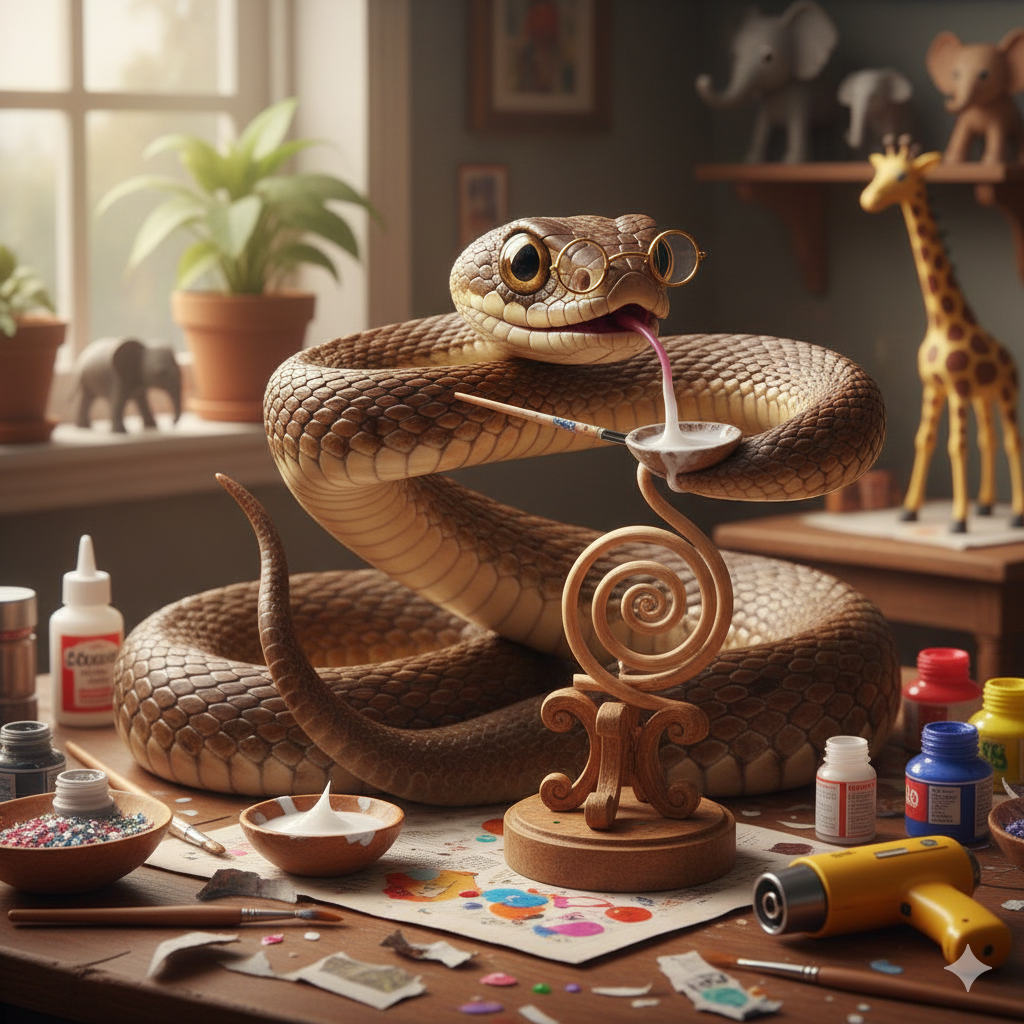
As I hinted at last chapter, it doesn’t make sense for Adam (or “the woman”) to be suspicious of the snake. It’s just one of God’s perfect creations which these innocent children, who don’t know right from wrong, would have no frame of reference to distrust. More on that later.

More importantly: this snake talked. It had vocal chords. It could speak super ancient proto proto proto Hebrew or whatever language God taught Adam and Eve.

The cult deals with this in a few different ways. Reasonable members consider it a myth. Less reasonable members say that if God made the universe, don’t you think he could make a snake talk? Well, yes, but… why? Why would God do that? Is he purposely setting humanity up for failure? Is that why he set up the day of rest in chapter one?

No, it’s the devil! It’s Satan, up to his nasty tricks. Okay, but then why would he present himself as a creepy, crawly, venomous creature? If I were looking to deceive some sweet innocent children, I’d appear as a fluffy panda or something. It seems like this might be another myth to explain why humankind is (typically) scared of snakes.

What’d you say?

We get a weird game of telephone with Adam standing by, completely aloof.

The snake seems to know what God said to Adam, but gets it a little wrong. That makes sense, God did say it to the snake. Unless you think the snake is omniscient or overheard the parenting speech from the previous scene, there’s no reason to think the snake knew the details of the little game God had set up for his beloved, precious creation.

The snake asks a leading question and Eve responds, getting the details wrong. Fair enough. She also wasn’t there for the conversation and Adam, who is standing right beside her, doesn’t bother to listen in and help them out. Satan/the snake, a completely incompetent bad guy, and Eve a naïve, brand new person, try to figure out what the deal is with this magical fruit.

Ultimately, it’s God who is dropping the ball here. He’s set them up for absolute disaster.

God makes the fruit attractive

Genesis 3:6

When the woman saw that the fruit of the tree was good for food and pleasing to the eye, and also desirable for gaining wisdom, she took some and ate it. She also gave some to her husband, who was with her, and he ate it.

This is an innocuous verse, but it seems to have some devastating implications for the doctrine of free will. Christians want to believe that they have free will because, as good little abuse victims, they want to blame themselves (or unbelievers) for all the suffering in this world. They’ll even point to this story as an indicator of that elusive free will.

But can it be a truly free will if God chose to make the fruit desirable looking to Eve? He gave her the desire. He made her in such a way that things that she’s drawn to things which look a particular way and then he made the fruit look that way. Where’s the choice in that?

Well, couldn’t he have made the fruit NOT pleasing to her eye? Would that have been an infringement on her free will? If making her repulsed by the fruit would be an infringement, making her desire it is an infringement. The only way her will would’ve been truly free is if she were indifferent to it.

It seems as if God wanted her to eat it and so he did everything he could to make that happen. After all, he wanted them to get tired so they could take a day off and think of him.

The other strange thing about this verse is that Adam was right there. What was he doing when his wife had a CONVERSATION WITH A SNAKE?! He’s so dang aloof!

Who really lied?

The phrase “in the day that you eat of it” came up last episode and it’s the phrase which makes God a liar and the snake a truth-teller.

God says they will surely die in that day.
The snake says they will not surely die [in that day] but their eyes will be opened and they’ll be like God (God left that part out).

They eat the fruit, in that day, and they do not die. Instead, their eyes are opened. God even confirms that later. The walking, talking snake got it right!

Not only don’t they die in that day, Adam lives longer than most people ever recorded in all of history. Almost an unbelievable amount of time!

The Curses

The curses in Genesis 3, much like the vague concept of free will, do a lot of heavy lifting when it comes to answering to the problem of suffering. There’s so much to say about the various ways this passage is exploited by the cult. I made a video dedicated to the common argument that things like disease and natural disasters and all other forms of suffering are a result of this moment. You can watch the video and read the companion article here!

For now, let’s explore how successful God is at curses. He’s God, so if he does a curse, you’d think he’d be able to make it stick.

The Serpent

It appears the curse is three-fold for the serpent.

  1. Cursed above (made lower than) all other animals
  2. Women will be creeped out by them
  3. No longer have legs

Did these curses come true? Yes and no.
Snakes are not really lower than all other animals. They’re physically low, unless they’re in trees, which many of them are. They’re also appreciated, celebrated, admired. There are even some women who own snakes as pets and truly love them. So, 1 and 2 have failed. It almost feels like more of a reflection of the attitudes of the people at the time.

But they still don’t have legs! That’s true. God nailed that one! That curse has been successful. One third of the snake curses was hit right out of the park. Great job, God!

The Woman

The woman seems to just get a double curse.

  1. More pain in childbirth
  2. Desire for her husband and he rules over her

Firstly, the pain is increasing, which indicates there was already pain there. So much for a perfect world, God. Pain, work, bodies that need rest. What a flop. But the childbirth pain thing has been fairly successful. We’ve beaten the curse with medication, but the pain is still kind of there. It’s a struggle. So, not bad.

However, the second one is not as successful. Women do not desire their husbands quite often. How many bits do people have to do about their wives not wanting to sleep with them before Christians realize this curse failed? Also, women are often the head of households. (Not to mention lesbians, equal partnerships, actually loving marriages, etc). This curse is pretty hit and miss. It almost sounds more like wishful thinking on the part of the men writing this tale.

I don’t know about you, but I like my curses consistent, especially when dolled out by an all-powerful, unchanging God.

The Man

The man gets one curse said in an elaborate way. It essentially tells us that he will have to work hard to produce food. This is a farming curse. I mirrors the pain in childbirth because the man was already working.

This one seems true to an extent, but we certainly have taken great strides in diminishing this curse through mechanisation. Is a curse much of a curse if you can beat it with a rototiller and a garden hose?

But it’s death

Death is hinted at in the curse for the man, but it doesn’t seem to be truly part of the curse. It’s kind of saying, you’ll be working till you die and eat from the dirt that you came from and from whence you will return. It’s poetic language.

But death is part of the punishment for eating the fruit, but it comes in a very interesting form.

Genesis 3:22

“The man has now become like one of us, knowing good and evil. He must not be allowed to… take also from the Tree of Life and eat and live forever.”

The way we would’ve been able to live forever is by eating some magical fruit, but not the magical fruit that made us know things, the other one that made us live forever, not unlike the fountain of youth or other mythical things.

It seems as though the default is that we were made to die, but there was way to eat ourselves to eternal life. However, we ate ourselves to death (eventually). Also, when I say “we”, I mean the characters in this story which, against my free will, represent me and all of humanity.

And that’s the most insane part of this, that everyone is still paying the penalty for this “crime” which was simply a couple of children being duped by a snake who they wouldn’t have been able to tell was evil (not knowledge of that, snakes are part of God’s good creation) to eat something God made look appetizing to them.

God is just?

Do you buy it?

I don’t.

If you’re not in a cult where you have been coerced by fear of hell to turn off your brain and think this is literal, any reasonable person can see that this is a myth designed to answer some simple questions.

  • Why do we die?
  • Why don’t we like snakes?
  • Why do we get to own women?
  • Why is farming so hard?
  • Why does childbirth kill women?
  • Why do snakes slither?
  • Why do we wear clothes?
  • Is an apple a day even safe?!

I’ve laid out countless problems if you want to believe it’s more than that. Check out Cancer is Not a Result of “The Fall” where I debunk that nonsense idea.

I’m going to say this a lot, but this chapter cannot carry the “theological” weight Christians put on it. It’s a myth designed to do other things, written very simply. Trying to co-opt it to account for the world being the way it is (and the way it isn’t, but Christians are taught it is) just makes it crumble.

That said, if this story is not true, then the Christian story of original sin, need for salvation, etc., all goes away too.

Thanks for reading and watch the video, there are some other ideas and observations there too!


Preview and Intro

I heard you in the garden and I was afraid because I was naked so I hid. That I relate to. I’ve never been someone that wants to go into men’s change rooms; it’s just because I’m insecure. Like, I don’t want to be seen naked, like in an intimate situation—cool, you know—where somebody is pretending like they’re into me.

Welcome to Joel Reads Bible. We are reading through the whole entire Bible, and every episode is a chapter and I make little remarks throughout. So far, we’ve had quite an interesting story. It feels a bit like a—I don’t want to say fairy tale. So far nothing is all that revelatory, but we’ll see what happens. I’ve got high hopes.

Genesis 3

Verse 1 Now the serpent was more crafty than any of the wild animals the Lord God had made.

I haven’t heard about the serpent, and I don’t know if the serpent was one of the options to be Adam’s helper, because I feel like you’d want a crafty helper. I mean, it depends what you’re doing. If you’re doing crafts, for sure. Serpents, of course, typically have no arms, but they can do a lot with their tail. I mean, some of them are just good musicians; they have a rattle.

He said to the woman, “Did God really say, ‘You must not eat from any tree in the garden’?”

Wait a second, this is interesting. Serpents talk now. Not the ones that you and I know—I’ve never heard a serpent talk—but this serpent allegedly talked. This is also a long time ago, in which things were maybe more evolved. Serpents may have had voice boxes. Christians have one issue with evolution: that there can’t be new information through mutation. Things can’t become more complicated; they become less complicated. And that may have happened here. You know, we may have had a more complicated serpent and then over time, and mutation, and evolution, serpents evolved to not be able to speak.

The serpent also is aware of what God said to Adam and now he is asking Eve about it. You want to assume that Adam let the woman know, and then the woman probably was just chatting with the serpent, like, “Yeah, we were told we can’t eat from this one tree.” And he’s like, “Did God really say you weren’t allowed to eat from any tree in the garden?”

Verse 2 And the woman said to the serpent, “We may eat fruit from the trees in the garden,

Verse 3 but God did say, ‘You must not eat fruit from the tree that is in the middle of the garden, and you must not touch it, or you will die.’”

So she obviously—this is a game of telephone because she didn’t get it right. You can touch it. I mean, God never said don’t touch it, unless there’s like part of the quote that’s missing from earlier. “You are free to eat from any tree in the garden; but you must not eat from the Tree of the Knowledge of Good and Evil, for when you eat of it you will surely die.” It is quoting itself in the next chapter and in that quote it adds you can’t even touch it. Maybe Adam was like, “Don’t even touch it. Okay? Don’t eat from it, but don’t even touch it, woman.” I don’t know why she’s my helper; she’s daft.

Verse 4 “You will not surely die,” the serpent said to the woman.

Verse 5 “For God knows that when you eat of it your eyes will be opened, and you will be like God, knowing good and evil.”

It is assumed at this point that Eve doesn’t know good and evil. She doesn’t get the concepts. That’s a perfect world, not knowing. Like, ignorance is bliss. You don’t know good, but you’re kind of like neutral. That’s great. Or do we really want extremes? I mean, they’re still naked; that must be nice. And they don’t feel shame; they probably enjoy looking at each other and probably the fruit does taste pretty good. But morally speaking, I guess that’s what they mean by good and evil. It’s morals. They don’t have a concept of morality. Great.

And this is also interesting that when you eat of it your eyes will be opened. So I guess right when you eat it your eyes will be opened. But it says here that when you eat of it you will surely die. So right when you eat it you will surely die? I mean, it’s similar wording so I think we can assume that right when you eat of it, your eyes open and you understand good and evil.

Verse 6 When the woman saw that the fruit of the tree was good for food and pleasing to the eye, and also desirable for gaining wisdom,

So interesting that we look at the knowledge of good and evil as wisdom. Those concepts are moral questions, but knowing what is constructive and what is destructive, or what will cause suffering and what won’t cause suffering—those are actually sometimes more difficult questions than you might imagine.

Sometimes I’m going to go on little rants and I apologize, by the way. If you like my little jokes or you like my little rants, leave a note in the comments to say, “Hey, we like that,” or, “Why don’t you just read the thing and shut up?”

When the woman saw the fruit of the tree was good for food and pleasing to the eye and also desirable for gaining wisdom, she took some and ate it. She also gave some to her husband, who was with her, and he ate it.

Who was with her. Sometimes you hear that, you know, it was Eve—it was the woman—she took it and then she brought it to him. She didn’t bring it to him; he was standing right there. You know, the serpent’s like, “Hey, you know, by the way, Eve, let me talk to the woman. Let me talk to the woman, she’s the dumb one.” (And by the way, I’m not saying all women are dumb; the character of the serpent in this little skit I’m doing thinks she’s the dumb one.) He’s like, “Let me talk to her; stay out of this.” And Adam’s like, “Okay, just let me know when you’re done.” He’s like, “Ah, you’re actually going to be like God. You’ll know good and evil, which you are a child, you don’t know that right now.” What’s she going to do? She’s just like, “Okay, that sounds fine.” She doesn’t know if it’s good or evil. They don’t have a concept of that.

I don’t know if she’s going to be held accountable in any serious way for this. I don’t think she should be. She could still be basically a newborn. We don’t have a timeline, but if the woman was made as a baby, Adam would have been an adult and he had to wait till she grew up to be at least probably 9 or 11 or something like that. I don’t know what—biblical doesn’t really have an age cutoff. I don’t think we’ll find out because one thing that I’m looking forward to is reading where the age range is for consensual sex, because that’s got to be in there because I know there’s a lot of rules about sex.

Eve goes, “All right, I guess I’ll eat this.” Adam’s like, “Huh.” Like, he’s there the whole time but then he’s like, “Huh? Oh, I just ate some of this. You want some?” And he’s like, “I guess so. Is everything fine with it?”

Verse 7 Then the eyes of both of them were opened, and they realized they were naked; so they sewed fig leaves together and made coverings for themselves.

What? They’re by themselves. They have privacy. For good—I mean, the serpent’s there.

Verse 8 Then the man and his wife…

That’s his wife? When did they get married? We’re just in chapter 3. They got married, by the way, at some point. They were wed. They got married and didn’t like seeing each other naked. I guess that’s what married couples are like. I’ve never been married; I still enjoy seeing women naked. But maybe when you are married you’re like, “Ah, cover that up,” you know what I mean? “Put on a fig leaf.” What’s going on here? Why did we eat that fruit? Put on a fig leaf, you’re disgusting.

Then the man and his wife heard the sound of the Lord as he was walking in the garden in the cool of the day,

God back in the day, I guess, went for walks but didn’t like too much heat because he does experience temperature like a human being, and he does get tired. He’s actually walking around. Well, they heard him walking and they hid from the Lord God among the trees of the garden.

Verse 9 But the Lord God called the man, “Where are you?”

Verse 10 He answered, “I heard you in the garden, and I was afraid because I was naked; so I hid.”

That I relate to. I’ve never been someone that wants to go into men’s change rooms; it’s just because I’m insecure. Like, I don’t want to be seen naked, like in an intimate situation—cool—but like, you know, where somebody is pretending like they’re into me. Like in just a room of dudes or something like that and we’re all like showering—I would feel very uncomfortable with that. So yeah, I would hide.

Verse 11 And he said, “Who told you that you were naked? Have you eaten from the tree that I commanded you not to eat from?”

So this is a leading question, probably, unless God doesn’t know. It’s like, “Who told you you were naked?” What are my options? The woman? God? Does God know about the serpent? Are there other talking things that could have told Adam that he was naked? What is that question there for? God is just like so mad. You know how like you get effervescent with rage and you go, “What? What? What are you talking about?” You don’t really want them to answer. It’s sort of like a placeholder for when you want to ask the real question. It’s like a rhetorical: “You’re naked? Who told you you were naked? Wait, have you eaten from the tree that I commanded you not to eat from?”

Verse 12 The man said, “The woman you put here with me—she gave me some fruit from the tree, and I ate it.”

You were standing right there! You saw the interaction with the serpent and you let it happen, essentially.

Verse 13 Then the Lord said to the woman, “What is this you have done?” The woman said, “The serpent deceived me, and I ate it.”

Well, the serpent deceived me. Now what I don’t get is that they do know about the knowledge of good and evil but they haven’t died yet, even though when you eat it you will surely die. So I don’t know if that part is coming true, or if when they say, “When you eat it you will have the knowledge of good and evil but when you eat it you will surely die,” maybe it isn’t like right when you eat it. Maybe they should have said, “Right when you eat it you’ll have the knowledge of good and evil, but when you eat it eventually you might die, or eventually you will physically die.”

Verse 14 So the Lord said to the serpent, “Because you have done this…”

He’s mad at the serpent. I would hate to be the serpent right now.

“Cursed are you above all the livestock and all the wild animals! You will crawl on your belly and you will eat dust all the days of your life.”

I’m gonna assume serpents had legs back in the day, which would have helped them be more crafty. They probably did origami or whatever. Now God cut off their legs, and I wonder if it’ll say this: and of course, remove their vocal cords.

Verse 15 “And I will put enmity between you and the woman, and between your offspring and hers; he will crush your head, and you will strike his heel.”

I know that has—that’s got to have significance. I’m sure that’s going to come back at some point. Remember that; someone remember that for me.

Verse 16 To the woman he said, “I will greatly increase your pains in childbearing;”

So I don’t know if she had had a child at that point.

“With pain you will give birth to children.”

He’s increasing the pain, so there was pain already going on but he’s increasing it.

“Your desire will be for your husband, and he will rule over you.”

Oh man. They probably were equals, but because she screwed up so badly in listening to the serpent—who told her something and she had no idea what was good or evil, so she couldn’t really make a rational decision because she didn’t have the frame of reference because she wasn’t made that way by the sounds of it—she now… “You are going to be ruled by your husband. A man is your boss.” There’s nowhere yet that we’ve read that the Bible is claiming to be an objective moral standard or infallible, so this might just be a fun, interesting story that we don’t need to take seriously.

Verse 17 To Adam he said, “Because you listened to your wife…”

Big mistake, man.

“…also because you listened to your wife and you were standing right beside her, and you didn’t stop her, and you heard the serpent, and you heard what I said, and you heard her misquote me… but just because you listened to her—big mistake—and ate from the tree from which I commanded you, ‘You must not eat of it,’ painful toil you will eat of it all the days of your life.”

So now gardening’s hard because Adam was way too aloof when he was standing beside Eve in the middle of the garden.

Verse 18 “It will produce thorns and thistles for you, and you will eat the plants of the field.”

This is the whole deal, like, men have to go to work, women stay home and they’re in pain bearing the child, they’re in pain giving birth. The man is the worker to bring home the bacon. You know, it’s setting us up for traditional family values.

Verse 19 “By the sweat of your brow you will eat your food until you return to the ground, since from it you were taken; for dust you are and dust you shall return.”

He wasn’t going to return to dust, but because he did that, now he’s cursed. I’m going to assume that’s what that is. When is that going to happen? It’s not that clear.

Verse 20 Adam named his wife Eve, because she would become the mother of all the living.

That makes sense. There’s just the two of them. Just the two of them. If they could bear to be naked together, she will be the mother of all. You know, if they can just—that’s going to be a lot of work for her. The mother of all the living, and it’s going to be painful. Oh Eve, why did you eat the pomegranate?

Verse 21 The Lord God made garments of skin for Adam and his wife and clothed them.

It sounds like that guy from Silence of the Lambs. I’m going to assume it means like leather from animals.

Verse 22 And the Lord God said, “The man has now become like one of us…”

Us? Now, I know that there’s a concept of a Trinity, so I don’t know if this is a hint towards that or if God is talking about angels.

“…knowing good and evil. He must not be allowed to reach out his hand and take also from the Tree of Life and eat and live forever.”

See, this is what happens when you don’t really read the Bible. If there’s a Tree of the Knowledge of Good and Evil that Eve can stand by in the middle of the garden, then there must be a literal Tree of Life that they could have eaten from and lived forever. And maybe that Tree of Life was like—they had access to that and they would have lived forever. Maybe that’s why they maybe were immortal? I don’t know, I’m just like anyone else, I’m making it up as I go along.

But then God said no, they can’t have it because they’re like us. God is powerful; he does get tired; he does not like too much heat, so he likes to walk in the cool of the evening; and he knows about good and evil. He also is pretty powerful because he can create the heavens and the earth and he can make people, and he also is a seamstress—I shouldn’t say seamstress, a seamster. He’s a leatherhead. He’s a bit of a fashion designer. This is as much as we know about God at this point.

Verse 23 So the Lord God banished him from the Garden of Eden to work the ground from which he had been taken.

Verse 24 After he drove the man out, he placed on the east side of the Garden of Eden cherubim and a flaming sword flashing back and forth to guard the way to the Tree of Life.

Why don’t they just go to the west side? Get in the garden there. Like, is there more than one entrance? Can he climb up a wall?

Closing Thoughts

That’s chapter 3. That’s pretty wild. It does seem a lot like a fairy tale. It doesn’t seem like it could possibly be true, but it does reflect what we know to be true. We know that serpents do crawl on their belly, so that does ring true. And we know that women do have pain in childbirth. And we know that we do have to work the soil; we have to work hard to get food. And we also know that we will die and we will become dust. These are taking into account truths about our existence and interjecting them into a story. Kind of like a child’s story. Very, very silly and, you know, talking serpent.

I don’t know if that serpent is going to be defined more in the future. At this point, I am seeing it literally as a serpent that had legs at a time and did talk and for no apparent reason deceived the woman. We may learn why, and these are good questions to have in the back of our heads. I think I know why because I’ve been told why, but where is it? So I’m looking forward to learning why, but we’re going to have to see what happens in chapter 4.

I’m having fun reading these. Please subscribe, like the video, ring the bell—all the stuff that people say at the end of these videos—and we’ll see you in the next one.

Subscribe!

For weekly emails regarding new posts, videos and more!