Preview and Intro “He loves God; he’s a huge fan. He just wants to please him. His heart was in the right place—like, he was really upset when he didn’t pull off the right offerings that he killed his brother. Cain just had some serious mental health issues; maybe he had psychopathic tendencies.
Welcome to Joel Reads Bible. I’m Joel, and I’m reading the Bible. This is a series where I am reading the Bible from front to back, beginning to end, Genesis to Revelation, Alpha to Omega—I don’t know if Omega is the last one. So far, God’s made everything. He’s made Adam, and we learned Adam’s partner’s name was Eve. And unfortunately, something horrible happened. Eve, with Adam right beside her, ate from this Tree of the Knowledge of Good and Evil. They got the knowledge of good and evil, and because they did that, they’re not going to live forever. So now we’re into Genesis chapter 4.”
Verse 1 “Adam lay with his wife Eve, and she became pregnant—nice—and gave birth to Cain. She said, ‘With the help of the Lord, I have brought forth a man.’”
Verse 2 “Later she gave birth to his brother Abel. Well, why don’t we get the sexy detail of Adam lying with her again? You know what I mean? Now Abel kept flocks, and Cain worked the soil.”
Verse 3 “In the course of time, Cain brought some of the fruits of the soil as an offering to the Lord. Oh, interesting take. So we need offerings? That never happened before; this is new. God is requiring—well, it doesn’t say he requires it; maybe Cain is doing this of his own free will.”
Verse 4 “But Abel brought fat portions from some of the firstborn of his flock. Nice. The Lord looked with favour on Abel and his offering,”
Verse 5 “but on Cain and his offering he did not look with favour. So Cain was very angry, and his face was downcast.”
Verse 6 “Then the Lord said to Cain, ‘Why are you angry? Why is your face downcast?’ I love this because it’s like the God character is sort of speaking what the narrator just said. It’s something that would happen comedically. I think Arrested Development has done a similar joke, but like, Cain was very angry and his face was downcast, and the Lord said to Cain, ‘Why are you very angry? Why is your face downcast?’ It’s comical if you do it.”
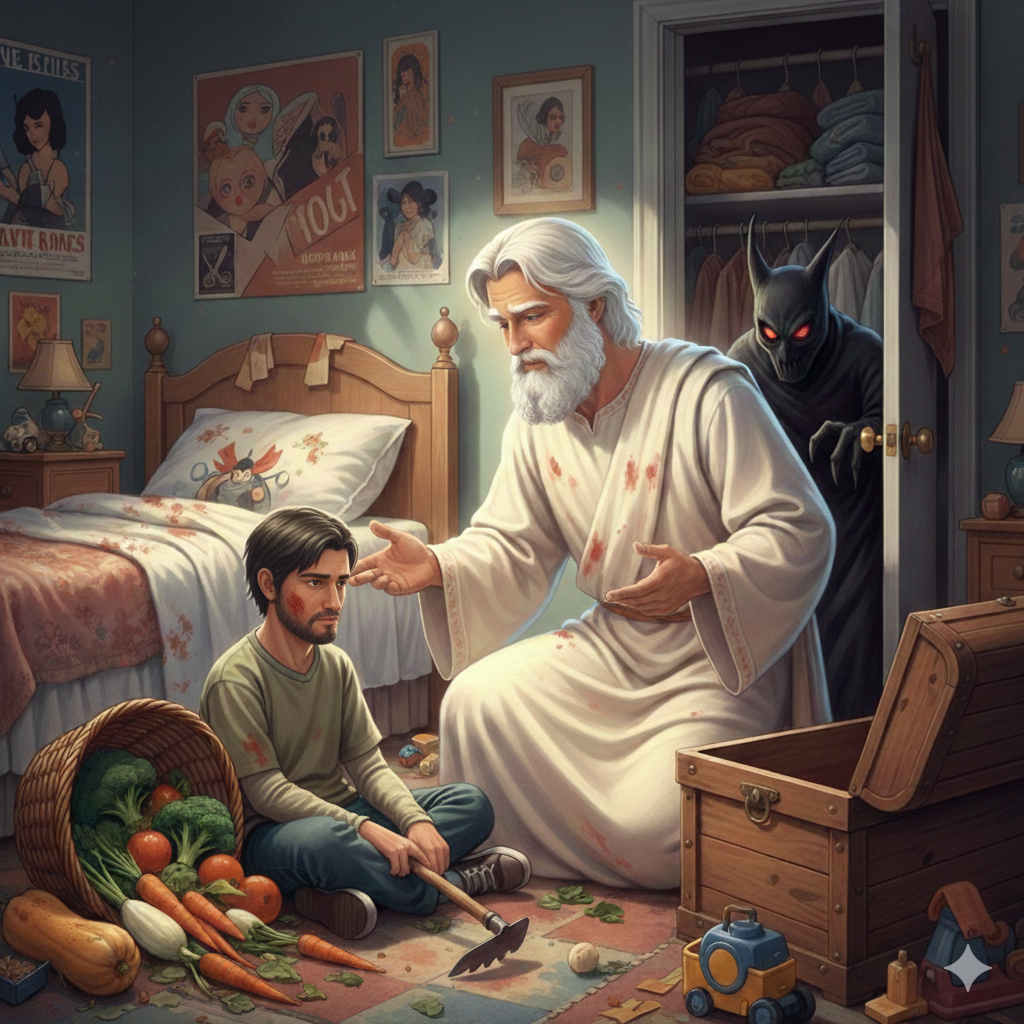
Verse 7 “’If you do what is right, will you not be accepted? But if you do not do what is right, sin is crouching at your door; it desires to have you, but you must master it.’ At some point, we have to assume that the Lord told Cain and Abel and Adam and Eve how to do offerings, how to do sacrifices. We don’t know this yet—the narrator hasn’t told us—but he must have told them. And God loves fat animals. How do we feel about plants? Not so great, you know what I mean? And it could be that Cain wasn’t bringing the most plump corn; you know what I mean? It might have been that the tomatoes were a little bit lean. He may have been saving the ones that he knows are going to be delicious and, you know, that’s in the salad, but ‘these ones are for you, God.’ God’s like, ‘Listen, you’ll be accepted if you do what’s right.’ Cain knows what that is. Sin is crouching at your door.
So this is so interesting: sin is external. This is the first mention of sin, and it’s crouching at your door. It’s an external force; it desires to have you. The first mention of sin doesn’t say sin is inside you and you are a sinful creature, etc. It says sin is crouching at your door; it desires to have you. You are fighting against the external force of sin. Sin, by the way, has desires. Sin is something with, by the sounds of it, an intelligence. I accept that this could be poetic license; it might not be what sin actually is. But this is the first mention we have of sin, and I’m sorry that I’m harping on about it, but to understand what sin is—this is the book for it. Sin is not a thing outside of religion, and it desires things.”
Verse 8 “Now Cain said to his brother Abel, ‘Let’s go out to the field.’ And while they were in the field, Cain attacked his brother Abel and killed him.
That was quick. I’m probably going to bring this up more than once, but a lot of Christian stuff—they love to throw around the idea of ‘family values.’ This is the first family: right away, murder. I mean, I’ve got brothers; they’re not this bad. Let’s just say that. He attacked him and he killed him, and that’s over some jealousy. But what’s so crazy about it is that Cain is angry and downcast because God doesn’t like his gift as much. He wants God to like him; he wants to please God, but not enough to actually do the right thing. And he is going to kill his brother. What are—they’re inbred? That is part of the problem, I think. They’re inbred; they’re not smart. They haven’t thought it through. And I think part of it might be that sin was crouching at his door and it got through. It desired to have him, and it had him. He did not master that sin. They do not think; they don’t reason very well. They’re a lot like Christians, I guess, in that sense—but you know, that’s a potshot. That’s a potshot; I don’t mean that.”
Verse 9 “Then the Lord said to Cain, ‘Where is your brother Abel?’
So this is God. He’s done this before. God is cheeky. This is part of the character of God, like, ‘All right, let’s see if he lies to me.’ Asking questions like this—it feels a little bit like a test, which I always thought of as gaslighting. ‘But where is your brother Abel?’ Cain replied, ‘I don’t know. Am I my brother’s keeper?’ So Cain is like, ‘You know,’ and he thinks he’s getting away with it. I’m guessing we’re going to find a lot of situations where you think people would know better. You and I don’t have a face-to-face relationship with God—I’m not saying Cain did—but there’s some vocalizing here, like there’s some words being spoken. There’s like a dialogue. And God walked in the garden—or well, he walked in the garden, I don’t know if he’s still on Earth. Probably not; probably just generally got too hot for him. But he is still like, ‘Okay, don’t you think he would be like, “Uh-oh, he’s going to know, he’s going to know”?’”
Verse 10 “The Lord said, ‘What have you done? Listen!’
It feels like he may have slapped him. ‘Listen!’—exclamation mark. ‘What have you done? Listen! Your brother’s blood cries out to me from the ground.’ That’s got to be poetic.”
Verse 11 “Now you are under a curse.
‘I cursed your mom, I cursed your dad, I cursed the serpent—now I’m cursing you. I’m sorry, Cain, but now you are under a curse and driven from the ground, which opened its mouth to receive your brother’s blood from your hand.’”
Verse 12 “’When you work the ground, it will no longer yield its crops for you. You will be a restless wanderer on the earth.’
Sorry, bud. You were not even a great gardener, by the way; got to tell you, I wasn’t pleased with what you were doing. So it’s no great loss to me. You can now try all you want to water the geraniums; they’re not going to grow. Okay, buddy? Sorry. But now all you’re going to be doing is wandering. I don’t know what he’s going to do for food—probably just get livestock, which is better anyway.”
Verse 13 “Cain said to the Lord, ‘My punishment is more than I can bear.’”
Verse 14 “’Today you are driving me from this land, and I will be hidden from your presence.’
He loves God; he’s a huge fan. He just wants to please him. I get it; he didn’t do it right, but it seems like his heart was in the right place. Like, he was really upset when he didn’t pull off the right offerings and then he got so mad that he killed his brother. I have a feeling that Cain just had some serious mental health issues; he wasn’t quite able to think clearly and coherently. Maybe he had psychopathic tendencies. I’m not a psychiatrist; I don’t know how to diagnose these kinds of issues that people might have. He’s obviously obsessed with God; he wants to get it right. And then when he doesn’t, he goes off the deep end. His heart breaks because he’s like, ‘I want to be near you; I don’t want to be far away from your presence. I’m crazy about you.’ ‘I will be a restless wanderer on the earth, and whoever finds me will kill me.’ Oh, maybe he’s just worried about his life. Maybe he’s like, ‘Uh-oh, I’m wandering, yeah, but also I feel like people are just going to kill me.’”
Verse 15 “But the Lord said to him, ‘Not so; if anyone kills Cain, he will suffer vengeance seven times over.’
Who’s he talking to? Who’s going to find him and kill him? There’s one family! One of his other brothers? Like, he’s going to be so old before those other generations grow up and then they’re able to find him and be like, ‘Hey, I thought we were the only family. Who are you, Cain?’ You know, is everyone suddenly a murderer? Like that? No, murderer is just common now. ‘God, you don’t get it. If they come and find me, they’re going to murder me because I’m not someone that tills the land anymore. I’m just a wanderer, and you know how they always just kill wanderers.’ It just seems a little bit fictional. Then the Lord put a mark on Cain so that no one who found him would kill him. So that’s actually kind of nice; no one’s going to kill Cain.”
Verse 16 “So Cain went out from the Lord’s presence and lived in the Land of Nod, east of Eden.
Which notoriously was a difficult place to sleep because at night you could see the flaming sword which was being whipped around constantly by the cherubim—watch previous videos, you’ll learn about that.”
Verse 17 “Cain lay with his wife—where did she come from?—and she became pregnant and gave birth to Enoch. Cain was then building a city, and he named it after his son Enoch.”
Verse 18 “To Enoch was born Irad, and Irad was the father of Mehujael, and Mehujael was the father of Methushael, and Methushael was the father of Lamech.
Just so you know: where are the women coming from? Like, where are all the women that they’re ruling over? We know that from the previous chapter, but where are they getting—when the Bible doesn’t mention it, it’s not important. For instance, here: it’s important what the men’s names were. It’s so important—every single man. The women are not important. Where they came from and whose daughters they were is not important. What’s important is just those guys.”
Verse 19 “Lamech married two women, one named Adah and the other Zillah.”
Verse 20 “Adah gave birth to Jabal. I’m not going to be pronouncing these names correctly. He was the father of those who live in tents and raise livestock.”
Verse 21 “His brother’s name was Jubal; he was the father of all who play the harp and flute. This is probably where we get the name the word ‘Jubilee.’ That’s neat.”
Verse 22 “Zillah—Godzilla—also had a son, Tubal-Cain, who played the tuba—no, that’s not true—Tubal-Cain, who forged all kinds of tools out of bronze and iron. Tubal-Cain’s sister was Naamah.”
Verse 23 “Lamech said to his wives, Adah and Zillah, ‘Listen to me; wives of Lamech, hear my words. I have killed a man for wounding me.’
Murder is more common. But I mean, this is Lamech, by the way—great-great-great-great-great-great-grandson of Cain. So it’s in the bloodline. ‘I have killed a man for wounding me, a young man for injuring me.’”
Verse 24 “’If Cain is avenged seven times, then Lamech seventy-seven times.’
He’s proclaiming his own Mark of Cain, if you will. You know, you kill Cain, you’re going to get it; you kill Lamech, 77 times. He’s just kind of making that up. I do want to bring up that Lamech has two wives. That seems fine; there’s no problem with that. I don’t know where all these women are coming from; they were probably his sisters. But he got two of them. And it could have also been that he was the only guy. You know, it didn’t say that like Methushael was the father of Lamech and Tobias. It was just Lamech, and he may have been the father of Adah and Zillah—or maybe Zillah was his mom too, who knows? But at that point, there could be a little bit more diversity because it could have been like one of them could be the granddaughter of Enoch’s other son. I think it is fun that there’s polygamy here and that there doesn’t seem to be a problem with it. Is it wrong? Are we going to learn that it’s wrong, or is this great? Is this just something we can do?”
Verse 25 “Adam lay with his wife again, and she became pregnant and gave birth to a son and named him Seth, saying, ‘God has granted me another child in place of Abel, since Cain killed him.’”
Verse 26 “Seth also had a son—with whom we will not know—and named him Enosh. Nice. At that time men began to call on the name of the Lord.
What’s that supposed to mean? I mean, they were doing offerings already, but now they just started calling on them anyway.”
Closing Thoughts “That’s chapter 4, so who knows what’s going to happen in chapter 5. I’m excited to find out. If you’re excited to find out too, please subscribe. If you have a comment on this book or if you notice something that I read that I didn’t pick up on and I didn’t mention, please leave it in the comments and enlighten everybody that’s watching. Because that’s part of the journey here is that we’re really reading the Bible—we’re not cherry-picking, I’m not telling you what it says, we’re not listening to some person who’s going to claim that they know what this interpretation means. We’re just taking the words at face value. And I think you’re able to do that because it’s the infallible word of God, which is inspired and revelatory. So let’s continue. I’ll be back for chapter 5, of course. Bless you.”
Hey, Joel. You’re onto something when you talked about Abel giving the firstborn of his flock. Both Cain and Abel are giving their livelihood as a sacrifice. There’s a contrast between what the two gave for sure. By comparison, Cain gave *some* of his crops, implying that it wasn’t anything out of the ordinary. Hebrews 11:4 speaks to this, saying “By faith Abel brought God a better offering than Cain did. By faith he was commended as righteous, when God spoke well of his offerings. And by faith Abel still speaks, even though he is dead”. Consistently in scripture, God examines our hearts and motivation. In this case Cain’s heart was in a place that was lacking.
More importantly, though, I think that looking at passages in this way reveals an issue with the premise of the examination in the first place. The overarching question between this and other breakdowns is “if God is good, then why did He do ______?”. There’s a really big problem with judging the actions of God as being bad or good. No matter what, if God exists, then He would be the standard of good and evil. Essentially, if we were to disagree with something He did, then we’d already be deemed incorrect by definition. What you’re really saying is that from your own limited perspective, you can’t understand why God would do something like that. Well of course, if we as finite beings could 100% understand an infinite God, then that wouldn’t be God at all. In fact, if there is no God, then morality is subjective and it would be impossible to deem anything as good or bad since there’s no absolute foundation. It’s a fallacy, in my opinion, to say that God wouldn’t exist or that the Bible is false, just because we disagree with the state of things.
What we really should focus on in terms of disproving the Bible is evidence surrounding the gospel and resurrection itself. If that part of the Bible is trustworthy, it legitimizes everything that came before, including this particular story. Reading a passage and
The reimagining of Hebrews is neat, but they’re just adding to the story. Obviously God preferred Cain’s offering, but it could be that he loves the smell of burning flesh, which is reflected in the burnt offerings he commands in the Torah. The Cain/abel story is likely just a foreshadowing to that. I mean, he wanted the first fruits before the whole firstborn thing tho the firstborn thing is the explanation for the dedication of the firstborns. It’s a bit of an anachronism.
I think my main problems with this story is in the narrative and poor character motivation. But yes, the God character certainly doesn’t know how people will react to his blunt communication. He should’ve supported Cain’s failing mental health. But that’s me taking this rudimentary folk tale seriously.